
Published on August 21, 2026
Can WhatsApp Messages Be Used as Evidence in Turkish Courts? Screenshots, Deleted Messages and Unlawful Evidence
WhatsApp has become one of the most frequently encountered sources of electronic evidence in Turkish legal proceedings.
Messages may become relevant in divorce proceedings, employment disputes, debt claims, harassment cases, threats, insults and criminal investigations.
However, the existence of a WhatsApp screenshot does not automatically mean that a case has been proven.
Turkish courts may need to consider how the messages were obtained, whether they are authentic, whether they have been altered and how they relate to the dispute.
Can WhatsApp Messages Be Used as Evidence in Turkey?
Yes.
Article 199 of the Turkish Code of Civil Procedure recognizes electronic data capable of proving disputed facts as a form of document.
Accordingly, WhatsApp messages, emails, photographs, videos and similar electronic records may be submitted as evidence in civil proceedings.
Their evidential value, however, depends on the circumstances of each case.
Is a WhatsApp Screenshot Enough?
A screenshot may be submitted to a court, but a screenshot does not automatically constitute conclusive proof.
The opposing party may argue that:
• The message was not sent by them,
• The screenshot was edited,
• Part of the conversation was omitted,
• The account belonged to another person.
The court may therefore consider additional evidence where necessary.
This may include the original device, complete conversation history, witness statements or expert examination.
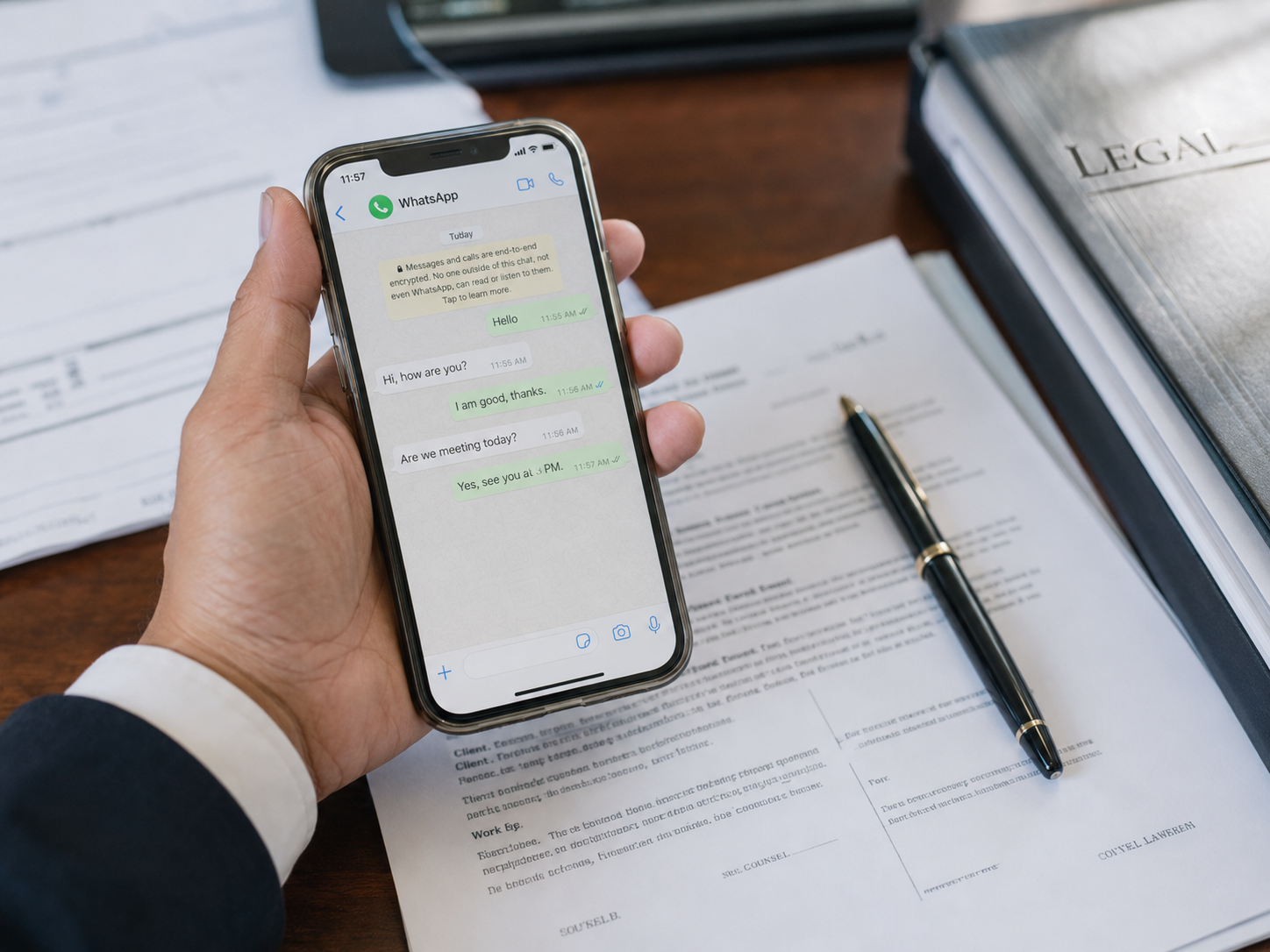
What Happens If the Authenticity of the Screenshot Is Disputed?
If a party denies sending the alleged messages, authenticity may become an important issue.
Depending on the case, technical examination of the relevant device or electronic records may be requested.
The court may evaluate the WhatsApp evidence together with other available evidence.
Can WhatsApp Messages Be Used in Divorce Proceedings?
Yes.
WhatsApp conversations are frequently relied upon in Turkish divorce disputes concerning allegations such as:
• Infidelity,
• Insults,
• Threats,
• Humiliating behaviour,
• Financial abuse,
• Family responsibilities.
However, the way in which the messages were obtained is also important.
Can I Secretly Access My Spouse's Phone to Obtain Evidence?
Secretly accessing another person's phone or messaging account may create significant legal problems.
Marriage does not automatically eliminate an individual's right to privacy.
A court may therefore have to consider whether the evidence was obtained unlawfully.
Individuals should not hack passwords, secretly connect to another person's WhatsApp account or install surveillance software merely for the purpose of collecting evidence.
Are Accidentally Discovered Messages Different?
Potentially.
A message that becomes visible accidentally on a jointly used device may require a different legal assessment from systematically bypassing another person's password and monitoring their private conversations.
The circumstances of the evidence collection are important.
Can WhatsApp Messages Prove Infidelity?
They may contribute to proving allegations in divorce proceedings.
However, affectionate or intimate messages do not automatically establish every legal element of adultery.
The messages may be considered together with photographs, travel records, witness statements and other evidence.
Can Threatening WhatsApp Messages Be Used as Evidence?
Yes.
A person receiving threatening or insulting messages should generally preserve the original conversation.
It may be useful to retain:
• The sender's phone number,
• Message dates and times,
• Earlier and subsequent messages,
• Voice notes,
• Relevant photographs or videos.
Can WhatsApp Voice Notes Be Evidence?
Yes, depending on the circumstances.
A voice message voluntarily sent to the recipient is different from secretly recording a private conversation between other people.
Secret recordings may involve additional legal restrictions.
Can WhatsApp Messages Prove a Debt?
Messages acknowledging a debt may become relevant in debt and contractual disputes.
For example, a message stating:
“I will repay the 100,000 TRY I borrowed from you next month.”
may be relevant evidence.
However, the applicable rules of proof depend on the nature and value of the transaction.
Can Employee-Employer WhatsApp Messages Be Evidence?
Yes.
WhatsApp messages may be particularly relevant to:
• Overtime,
• Working hours,
• Shift schedules,
• Salary discussions,
• Instructions from managers,
• Leave requests,
• Termination of employment,
• Workplace harassment.
The messages are generally evaluated together with other employment records.
Can an Employee Be Dismissed Through WhatsApp?
A WhatsApp message may demonstrate that an employer intended to terminate employment.
However, whether the termination satisfies the legal requirements of Turkish labour law is a separate question.
Can Deleted WhatsApp Messages Be Recovered?
Sometimes, but not always.
Recovery may depend on:
• The device,
• When the data was deleted,
• Backup settings,
• Operating system,
• Subsequent use of the device,
• Available forensic techniques.
It is therefore inaccurate to claim that every deleted WhatsApp message can always be recovered.
Can a Court Ask WhatsApp for All My Messages?
It should not be assumed that a Turkish court can simply request a complete historical transcript of every WhatsApp conversation.
WhatsApp states that personal messages and calls are protected by end-to-end encryption.
Electronic evidence may instead depend on records contained on devices, backups, evidence provided by parties or other legally available sources.
Are WhatsApp Call Records Evidence?
Information showing that calls occurred may be relevant in certain disputes.
However, the existence of a call does not by itself establish what was discussed.
How Should Important WhatsApp Evidence Be Preserved?
Do not delete the original conversation.
Preserve the surrounding context rather than only one sentence.
Keep visible identifying information where appropriate.
Preserve dates and times.
Retain relevant voice messages, photographs and videos.
Avoid resetting or replacing the device before important evidence is secured.
Do not unlawfully access another person's account.
Is Notarisation Required?
Not every WhatsApp message needs to be notarised.
However, in disputes where electronic content may later be deleted or denied, reliable preservation of the evidence may be important.
Whether a formal determination procedure is appropriate depends on the circumstances.
Frequently Asked Questions
Are WhatsApp messages conclusive evidence?
Not automatically. Their authenticity, method of acquisition and connection with the dispute may be examined.
What if the other party denies the messages?
Additional evidence or technical examination may become necessary.
Can deleted messages always be recovered?
No. Recovery depends on technical circumstances.
Can WhatsApp messages be used in divorce cases?
Yes, provided their admissibility and relevance are evaluated according to the circumstances.
Can an employer use WhatsApp messages against an employee?
WhatsApp communications may be relevant evidence in employment disputes, subject to applicable privacy and evidence rules.
Conclusion
WhatsApp conversations can constitute important electronic evidence in Turkish litigation.
However, a message should not be evaluated only according to what it says.
Courts may also consider:
• Authenticity,
• How it was obtained,
• Whether the full conversation is available,
• Who sent it,
• Its relevance to the proceedings,
• Other supporting evidence.
Atalya Law Office provides legal services in Antalya in matters involving divorce law, criminal law, employment disputes and electronic evidence.
This publication is for general informational purposes and does not constitute legal advice for any particular case.

This content was prepared and reviewed by the legal team at Atalya Hukuk Bürosu.
Meet Our Team →Related Articles
Conditional Release and Probation in Turkey: Who Qualifies?
An overview of conditional release and probation under Turkish execution law: the good-conduct assessment, how the process works, and why applicable ratios should be confirmed with a lawyer.
Read More→
The Legal Process for Cryptocurrency Fraud: How to File a Complaint
A practical legal roadmap for cryptocurrency fraud victims: preserving evidence, notifying the exchange, filing a criminal complaint, and understanding the realistic limits of recovery.
Read More→
What Is an Ecrimisil Claim? The Cost of Living Rent-Free as a Co-Owner
When one co-owner of an inherited property lives there rent-free or collects all the rental income alone, the other co-owners can file an ecrimisil claim. Here is how it works.
Read More→