
Published on September 6, 2026
Court of Cassation Ends SGK's Mandatory Service-Consolidation Practice
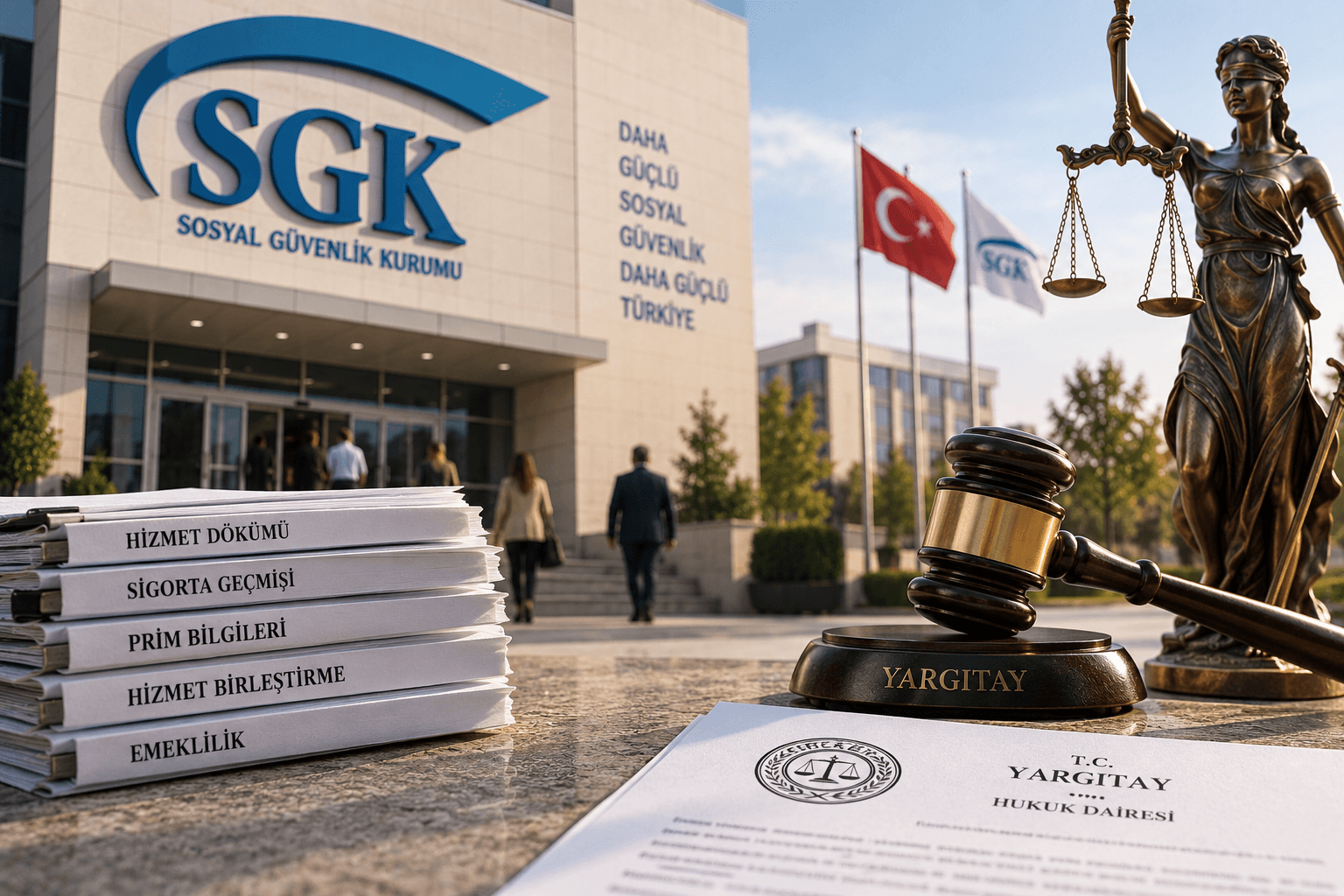
Court of Cassation Ends SGK's Mandatory Service-Consolidation Practice
An important Court of Cassation decision has emerged that closely affects — and will impact millions of — insured individuals who worked under different social security schemes (SSK, Bağ-Kur, and the Pension Fund) at different points in their careers.
In its decision dated April 15, 2026 (Case No. 2025/565, Decision No. 2026/259), the Court of Cassation's General Assembly of Civil Chambers adopted an important principle regarding the retirement request of an insured person with service records under multiple social security schemes.
How Did the Dispute Arise?
In the case at hand, an insured person whose last 7 years of service were predominantly under the Bağ-Kur scheme was told by SGK (Turkey's Social Security Institution) that they had to retire under that scheme and complete their premium days (9,000 days) accordingly. This practice delayed the individual's retirement.
The insured person objected to this consolidation, which wasn't their own choice, and filed a lawsuit.
The Court of Cassation's Assessment
The Court of Cassation's General Assembly of Civil Chambers emphasized that a court must rule within the bounds of the request explicitly stated in the plaintiff's petition.
Under the decision, insured individuals with different periods of service under SSK, Bağ-Kur, or the Pension Fund cannot be forced into service consolidation against their will.
What Does This Mean for Insured Individuals?
Following this decision, insured individuals will be able to request the consolidation of whichever schemes provide them the highest pension and earliest retirement, while excluding service periods that don't work in their favor from the calculation.
The decision is especially significant for insured individuals who worked under multiple social security schemes over their careers and faced delayed retirement or a lower pension due to SGK's consolidation method.
Source: Court of Cassation, General Assembly of Civil Chambers, Case No. 2025/565, Decision No. 2026/259, dated April 15, 2026.
This content has been prepared for general informational purposes only and does not constitute legal advice. We recommend consulting a lawyer to assess how this decision applies to your specific situation.

This content was prepared and reviewed by the legal team at Atalya Hukuk Bürosu.
Meet Our Team →Related Articles

Conditional Release and Probation in Turkey: Who Qualifies?
An overview of conditional release and probation under Turkish execution law: the good-conduct assessment, how the process works, and why applicable ratios should be confirmed with a lawyer.
Read More→
The Legal Process for Cryptocurrency Fraud: How to File a Complaint
A practical legal roadmap for cryptocurrency fraud victims: preserving evidence, notifying the exchange, filing a criminal complaint, and understanding the realistic limits of recovery.
Read More→
What Is an Ecrimisil Claim? The Cost of Living Rent-Free as a Co-Owner
When one co-owner of an inherited property lives there rent-free or collects all the rental income alone, the other co-owners can file an ecrimisil claim. Here is how it works.
Read More→